
Pancake heaven
Shrove Tuesday is now gone but I’d like to think that pancakes can return to Lia’s kitchen before the next one in 2014.
Pancakes don’t always have to be overindulgent naughty treats. Not that there’s anything wrong with that.
I hope this post becomes a quick and easy pancake recipe reference and an inspiration for an alternative savoury filling.
This recipe was given to me by Dan Green who, hat’s off to him, makes the best pancakes I have ever had-he flips them and all that! I just followed his instructions to make the batter, made a filling with what we had in the fridge and watched him put the pancakes together skilfully for us.
Aubergine and fenugreek pancake filling ingredients
1 small aubergine, cubed in 2cm pieces
Half an onion finely chopped
Half a tin of chopped tomatoes
Pinch of cinnamon powder
3-4 handful fresh fenugreek leaves roughly chopped
100gr or more grated cheddar
Filling preparation
Stir fry the aubergine, onion and a pinch of salt for five minutes.
Add the chopped tomatoes and cinnamon, stir and cook for five to ten minutes on low heat until soft and cooked.
Season with some salt and pepper (2-3 pinches of salt suggested).
When nearly ready add the fresh fenugreek.
Add the cheese when filling the pancake in the pan and whilst the second side is cooking.
You can optionally add some fresh baby spinach leaves when filling the pancake.
This is enough filling for four small pancakes.
Pancake Batter ingredients
125gr Spelt or whole meal flour
300 ml milk
1 egg
A pinch of salt
Knob of butter from frying
Pancake preparation
Add all ingredients (not the butter) and whisk to mix well.
Let the batter sit in the fridge for 20 minutes or until you prepare your fillings.
Heat a non stick frying pan on high heat.
Melt enough butter to coat the pan’s surface.
Add about a ladle full of batter in your pan.
Lift and swirl until the batter evenly covers all the surface and almost ‘licks’ its sides upwards. [1]
Lower the heat and cook for a minute or until ready-that’s when it’s easy to flip.
Flip and whilst the pancake is cooking fill with preferred filling and cheese , or fruit and chocolate.
Fold in four in the pan.
This amount of batter should give you six small pancakes and plenty for two people.
Enjoy whilst hot!
[1] This should help you flip the pancake easier.

Oh sweet grain of Halva
My mother was here until last Monday, and I kid you not, she made the best halva of her mother career for us. It was one small little change in the simple foolproof recipe that she has been using all her life- she used lime instead of lemon and oh my was that a wonderful deviation.
The halva recipe follows the simple 1-2-3-4 rule, which is fool proof and depending on your unit of measure allows you to make more or less portions of halva. If you use a cup as a unit of measurement you should have enough desert for about six people.
Remember to allow some time for the halva to cool down slightly so that you can mould it into your chosen shape or individual portions.
This desert is easy, quick, cheap and everybody loves it. And the recipe is vegetarian, vegan and dairy free.
Here is how we do Halva in the Moutselou clan although admittedly I prefer to brown the halva a bit more than mom because of the toasted grain smell it releases in the house.
Ingredients
1 measure of olive oil
2 measures of coarse semolina
3 measures of sugar (you can easily reduce that to 2 or even replace with honey)
Peel of half or whole lime or lemon
1 cinnamon stick
A big handful of chopped walnuts
Some finely chopped walnuts for dusting and decoration
Some cinnamon powder for decoration
Preparation
Prepare a syrup adding the boiled water, the sugar, a cinnamon stick and lime or lemon peel to a heat proof bowl or pan.
Stir the sugar until dissolved, cover and let it sit long enough to unleash the lime and cinnamon flavours[i].
Heat the olive oil in a pan (preferably non stick) until it’s almost sizzling.
Add the semolina to the pan and brown, stirring continuously and until it reaches your preferred shade of semolina brown[ii].
Add a big handful of coarsely chopped walnuts halfway through your browning action.
Remove the lemon/lime peel, stir the syrup in the pan of browned semolina and either remove from heat or lower to minimum whilst you continue stirring.
Remove from heat and discard the cinnamon stick.
Let the halva mixture cool down for five minutes or more.
Mould either in a bundt cake tin or a loaf tin or in individual moulds of your choice, e.g. Greek coffee cups for smaller portions.
Dust with cinnamon powder and decorate with finely ground walnuts and.
Let the halva cool down before serving. The halva is delicious cold when left in the fridge overnight.
If you wish serve with grapes and decorate with single (soya) cream
Suggestions
[i] The longer you leave your syrup to sit the more flavoursome it will be but if you are in a rush you can just let it sit whilst you go through the next few steps.
[ii] Many people like to toast the semolina very slightly and until it absorbs the oil- if you prefer this your halva can look very pale and almost beige and could be very light. I love to brown the semolina to a heavier complexion but I would recommend a light tan for most beginners.
[iii] You will see the semolina expand.
Back to a classic: tomato sauce
I can think of a few things as comforting as a tasty tomato sauce poured generously over spaghetti. So for your convenience here is the quick recipe that has received top hits from all of Lia’s Kitchen readers in 2012.
https://liaskitchen.com/basic-tomato-sauce/
And if you fancy a variation don’t forget another favourite: Lia’s Kitchen carrot and tomato red sauce.
Enjoy!
Made in Aberaeron: Vegetarian red ‘carrot’ pasta sauce
We found the main ingredient for this new red carrot pasta sauce at the roadside between Temple Bar and Criblyn villages in Ceredigion, Wales.
A compulsory stop to find our bearings and the way to the little thatched cottage that would be our home for the weekend revealed a roadside stall with bunches of fresh organic carrots, homemade jams and eggs. This was still one of those places where you are trusted to pick what you want and leave the money.
We arrived ravenous at the cottage with a bunch of fresh small organic carrots, and fettuccine pasta, tinned plum tomatoes, the basics of garlic, salt and pepper, and the luxury of cinnamon in our travel cook box.
The recipe came together in my mind when I remembered an interview of Anna del Conte, the Italian food writer who raised awareness of Italian cuisine in the UK in the late 70s, and her mention to finely chopped carrots as a main ragu ingredient.
I coarsely grated the carrots for my recipe to infuse the sauce with the bright orange colour and the organic carrot flavours of this star ingredient. The result: a pure delight and a fool-proof vegetarian ragu sauce that is guaranteed to please and comfort. Yum!
Ingredients
- 7-8 small and fresh organic carrots, coarsely grated
- 2 tins of plum tomatoes
- 1 medium onion, finely chopped
- 3 garlic cloves, finely chopped
- 1 tsp cinnamon powder
- 1 tsp sugar
- Salt and pepper
- Olive oil
- Half a pack of fettuccine or other dried pasta (120g)
Preparation
Coarsely grate the carrots after you have washed them well. No need to peel really fresh and young carrots.
Finely chop the onion.
Sweat and sauté the onion on low heat for a few minutes. Use a couple of tablespoons of olive oil.
Add the grated carrots and a couple of pinches of salt, and sauté in low heat for another ten minutes or so.
Add the two tins of plum tomatoes and a teaspoon of sugar.
Mash with a wooden spoon; add another pinch of salt or two, one or two teaspoons of cinnamon, stir and cover.
Simmer on low heat for thirty or fourtyfive minutes or until the liquid has been absorbed and the sauce has reached a thick ragu consistency.
Cover and let the sauce rest for at least fifteen or more. This helps the sauce bind and the flavours come out, patience is a key.
Serve with half a pack of fettuccine, strong crumbly cheddar and coarse pepper (we used Barbers cruncher, a West Country mature, sweet and crunchy cheddar) .
This recipe makes two very generous portions but you can share between three or four.
Smoked Haddock Salad
The Smoked Haddock Salad was created by chance to complement a colourful mid-week meal with two beautiful friends, the wonderful Chris, a loved fellow Cardiffian, whose company I have been enjoying so much lately (yey!!), and the beautiful Katerina who is brightening up our week with her express visit from Greece- ex Cardiffian (but always one at heart).
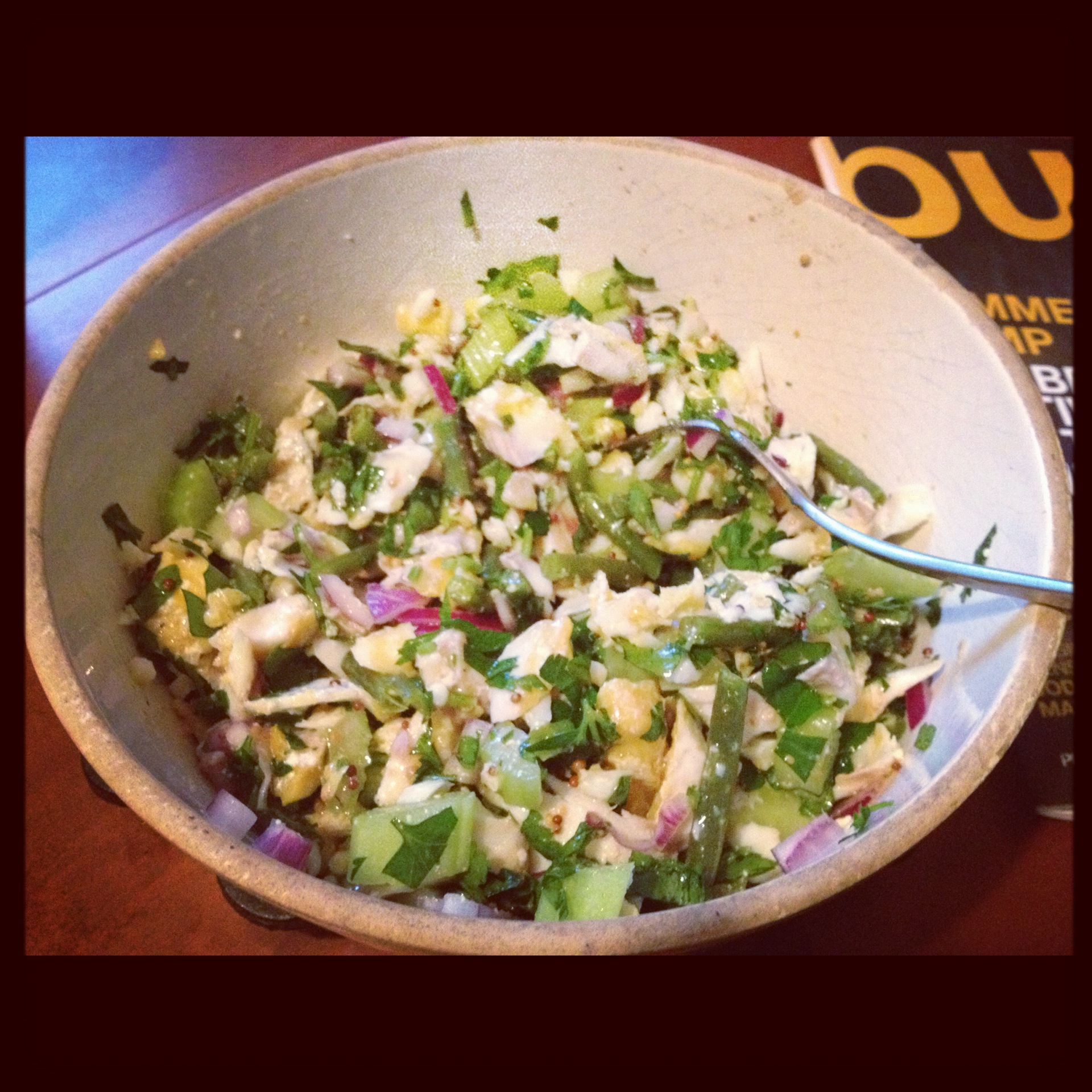
This fish salad tastes even better the day after when its simple flavours have infused the haddock overnight in the fridge.
The recipe was inspired by 300gr of smoked haddock that needed to be cooked on the day, our need for a light salad, and a quick google search for haddock salad recipes, of which eventually I followed none but one of which gave me the mustard vinaigrette idea.
It takes 15-10 minutes to makes and can be enjoyed warm too!
Smoked Haddock Salad: Feeds 4-6 as side salad and 2 for lunch
Ingredients
- 300gr skinless and boneless smoked haddock
- 300gr fine green beans chopped in three
- 2 celery sticks, thickly sliced
- a small bunch of flat leaf parsley, roughly chopped
- half a red onion , finely chopped
- 2 Tbsp whole grain mustard
- 1 tsp salt
- Olive oil
- 3 Tbsp cider vinegar
Preparation
- Add the chopped fine green beans in a flat, large shallow pan with 1/3 of it filled with boiling water.
- Simmer for five minutes, remove and drain. Keep the water boiling in the same pan.
- Add the whole fillets of smoked haddock and steam/simmer for ten minutes. Add a bit more boiling water if necessary.
- Prepare the vinaigrette by mixing in a jar the mustard, salt, cider vinegar and olive oil. Use as much olive oil as you think you need but at least five Tbsp. Shake the jar vigorously until the vinaigrette has a loose but creamy consistency. Adjust seasoning to taste.
- Remove the haddock and drain.
- Add haddock to a shallow salad bowl and flake roughly with a fork.
- Add the chopped parsley, beans and onion.
- Dress with the vinaigrette and mix well.
Enjoy as a light lunch or dinner for two on salad leaves or toasted rye bread , or as a light side dish.
Love your belly and your friends. 🙂 =love yourelf
The return of the humble: the sardine
Sardine is a humble nutritious fish that has offered me many meals at home and in taverns throughout my life.
We used to buy sardines in cone shaped newspapers. Mr Giorgos, the fishmonger in Thessaloniki’s Kifisia, the neighbourhood I grew up, used to fill them generously with big handfuls.
Saturday has always been a fish day at my parents house in Greece and also the day that mom looks forward to her little glass of ouzo or raki with some sardines or gavros (small fresh anchovies) as a starter. In the depth of winter we would grill sardines or bake them in tomato sauce in the oven. On sunny mild days and in the summer we would marinate them in with herbs, lemon and sometimes freshly grated tomatoes to grill outside attracting neighbours for an ouzo meze sit-down and most of the cats in the neighbourhood.
Below is a simple sardine recipe with a Ghanaian twist, a variation of an oven recipe I have enjoyed many times.
Ingredients
- 10 meaty and large sardines
- 3-4 freshly grated tomatoes or 2 grated tomatoes and half a tin of chopped tomatoes
- A large handful of kalamata olives pited and roughly chopped
- 1 full teaspoon of Ghanaian Shito sauce (optional)
- 2 tablespoons of olive oil
- Juice of 1 lemon
- Salt and pepper
- Oregano (2-3 pinches)
Preparation:
- Mix the tomatoes, Shito sauce, olives, lemon juice, olive oil, salt and pepper and oregano in a kitchen chopper for a few seconds, until just coarse but well mixed.
- Taste and season accordingly and if needed.
- Place the sardines in a baking tray, mix well in the marinade.
- Bake in a hot and then medium oven for 20 minutes or until cooked.
- Or if the barbequing season has started somewhere in the world where you might be, grill and enjoy out side. I guarantee that the sardines will taste even better.
Shito sauce is a Ghanaian sauce that consists primarily of fish oil and/or vegetable oil, ginger, dried fish and/or crustaceans, tomatoes, garlic and spices. It should be used in small quantities if you don’t like your dishes too spicy and hot. And it can be quite oily.
Fresh fish has clear eyes (non cloudy), red gills and a natural arch or curve. Buy wisely.
Crisis kitchen
No food today folks…
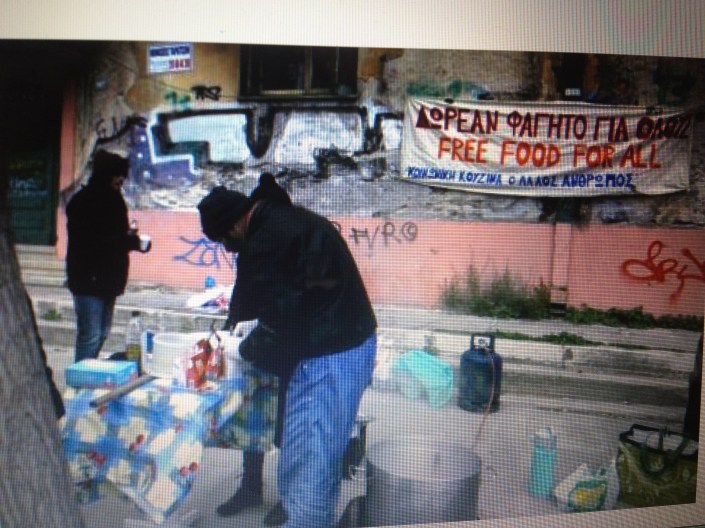
Today I saw photos of soup kitchens in Greece, again, with long and growing queues: this is not news it has been happening for a long time now, did you know about it? I heard about how small business owners gone bankrupt keep silent about their unemployment, too ashamed of the stigma. The stated unemployment percentage in Greece must be inaccurate with so many people keeping silent: there is no hope of help or social welfare. Not to mention the taboo of accepting charity help. In Greece, just around the corner from you, there are more and more stories on the steep increase of homelessness; parents giving up their children to social services; suicide on the rise. I saw images of protest on the streets of various cities in Greece on 10 February 2012 and massive protest banners adorning the Acropolis . And everyone if gearing up for massive protests.
When I left Greece 15 years ago, for what I thought then would be 3 years of British education, I could not have imagined this fate for Greece.
My parents were annoyingly hard-working. I remember their frustrated conversations about growing tax evasion and their comparatively high tax bills: they felt naïve and were sometimes mocked for their lack of ‘courage’ to evade tax. Do I believe that tax evasion is the only reason Greece is where it is? No, I think it was a symptom as well as a cause.
Can I comment about what is happening in Greece today? Unlike other Greeks all I have only been a professional adult in Britain; it is only through my parents, family and friends’ experience that I can comment. When some of my Greek friends, having been educated or worked abroad for a while, started making their way back ‘home’ in the early noughties-to make art; be lawyers, doctors, teachers; start businesses, or families; or just be with their families, or just to be-I stayed on. My choice until recently baffled quite lot of people but nowadays no one asks me why I am here. No disrespect but there is not much I will bother saying about my choice: it has been personal and therefore right; and had nothing to do with jobs, status and money, or indeed this crisis. Of my Greek friends who have returned to homeland, very few had a painless transition –sometimes being treated harshly for their choice of foreign education, and faced with nepotism and lack of meritocracy, even gender prejudice-and now they are getting this: an undignified financial junta, a monetary dictatorship, the loss of their dignity, a situation that seems to be going nowhere. Has part of the problem been that many Greek families and people contributed their money to the foreign economy through, e.g. education, rather than investing funds and skills in Greece? Some think so… I have reached no conclusion, and if yes I have contributed to this problem.
I am trying to understand what a solution to Greece’s demise might be: is the only dignified way out to default? I honestly don’t know, but it seemed to be the better choice for Argentina.
Still, I am particularly angry that my 75 year old father is at risk of being deprived of much deserved security in his older age: a man that has been working since he was 13; and who already experienced 2 recessions; a civil war and the end of the Second World War in Greece.
But as allegedly the UK is also entering another recession phase and unemployment in Wales particularly, but also across the UK, is rising, I once again conclude this is a global problem not one of or caused by Greece: to think otherwise is naïve and insulting to one’s intelligence! And I wonder what is to hit the UK too, after all the other countries queuing up for harsher times: after all personal debt in the UK is a lot higher than that of the Greeks. The past few years here seem resonant of the decade Greece went through before recession; there is a welfare state, but the family structures are not as tight. Once I swore never to make the mindless sacrifices to my personal life that my parents made for me. Ironically I now find myself working to pay hight taxes, a ridicuous mortgage, and bills; and not being able to entertain even the thought of some these mindless sacrifices.
So the question I pose to you wherever you are is:
How is it that across this world we accept to be governed by an incomprehensible force of fictional markets, a system that made very little sense until its collapse, and still remains nonsensical and ludicrous? It feels like a live version of monopoly, where countries like Greece are waiting for a get out of jail card…in vain.
My father stoically says that we will all be ok: I can hear him smile when he says this to me on the phone. On 12 February 2012, Greece will see mass protests. Tonight we all get on with our moods and lives as always: we will be ok but this does not mean we remain unaffected and indifferent. So that you know…
Recommendations:
‘The Argentina experiment’, an excellent documentary made by the Exantas team in Greece who visited the country ten years after recession and in the depth of the Greek Crisis.
Soup kitchens and stories of a growing number people seeking free meals in Greece in English
For the Greeks: Pandespani blog’s fantastically sarcastic and intelligent entry
As usual Kostas Kallergis site about the Greek Crisis: When the Crisis Hit the Fan
Guardian’s 10 February editorial about the crisis, the euro and Greece
My previous blog on our crisis: a recipe for destruction.
 Lia's Kitchen
A year of health and St Basil’s lucky coin of justice
Posted on Updated on
I just stored my lucky New Year coin protectively like a precious blessing. This year the coin will bring us health -this is what the New Year’s cake promised when we ceremoniously cut it on the 1st January 2013.
Every New Year’s Day-when we slice St Basil’s cake and eat through its aromatic brioche texture, flavoured with mastic and mahlepi, in search of the lucky coin- my British and other non-Greek guests ask where this tradition comes from and what it really means.
The person who receives the coin is destined to have a year of great luck. And every so often the coin falls to a special piece cut for the house or, like this year, for health.
So why do we do this?
The cake is named after St Basil who may have been the real Santa Claus (not the Coca Cola one) and who was an archbishop in Cappadocia. When Basil took over his post he realized that great injustice had been done to his town people through high unjustified taxation -that rings a bell does it not? To return town folk their fortune and to overcome the obstacle of how to identify the owners of the different items Basil decided to bake a massive cake and to place their precious stones, cold and coins in the cake. He then invited the whole town to a big celebration where that cake was cut ceremoniously. The myth says that miraculously each person received their own possessions in the piece given to them. After Basil died the cake ceremony became a tradition.
Tonight, well into 2013, I am contemplating my luck of which I have much. I found this a picture of this year’s New Year dinner and my lucky coin and thought I’d share my good fortune with you.
Be lucky, healthy and happy.
This entry is dedicated to Tom (28), Vaggelio(37), Lucy(32) who left us in the past seven years; to Pavlos and my wonderful aunts Claire and Ellie who beat and are beating cancer; and to our mental health which we all still have because of our own courage and the love of our friends and family.
Share this:
This entry was posted in Comment, Greek cuisine and tagged food, lucky coin, New year, st basil, stories.