
Spetzofái – the last of Blaencamel Farm’s Broad Beans Crop
Whilst I may have skipped a month of sharing recipe ideas with you inspired about one of my favourite places in Wales, it seems that the summer crop that has done so well on Blaencamel Farm’s land this summer keeps going strong this first week of September. This year the almighty broad bean has inspired various summer version of one of my favourite Greek dishes, Spetzofai, a stew which hails from beautiful Pelion on the Greek mainland (the land of the Cyclopes).
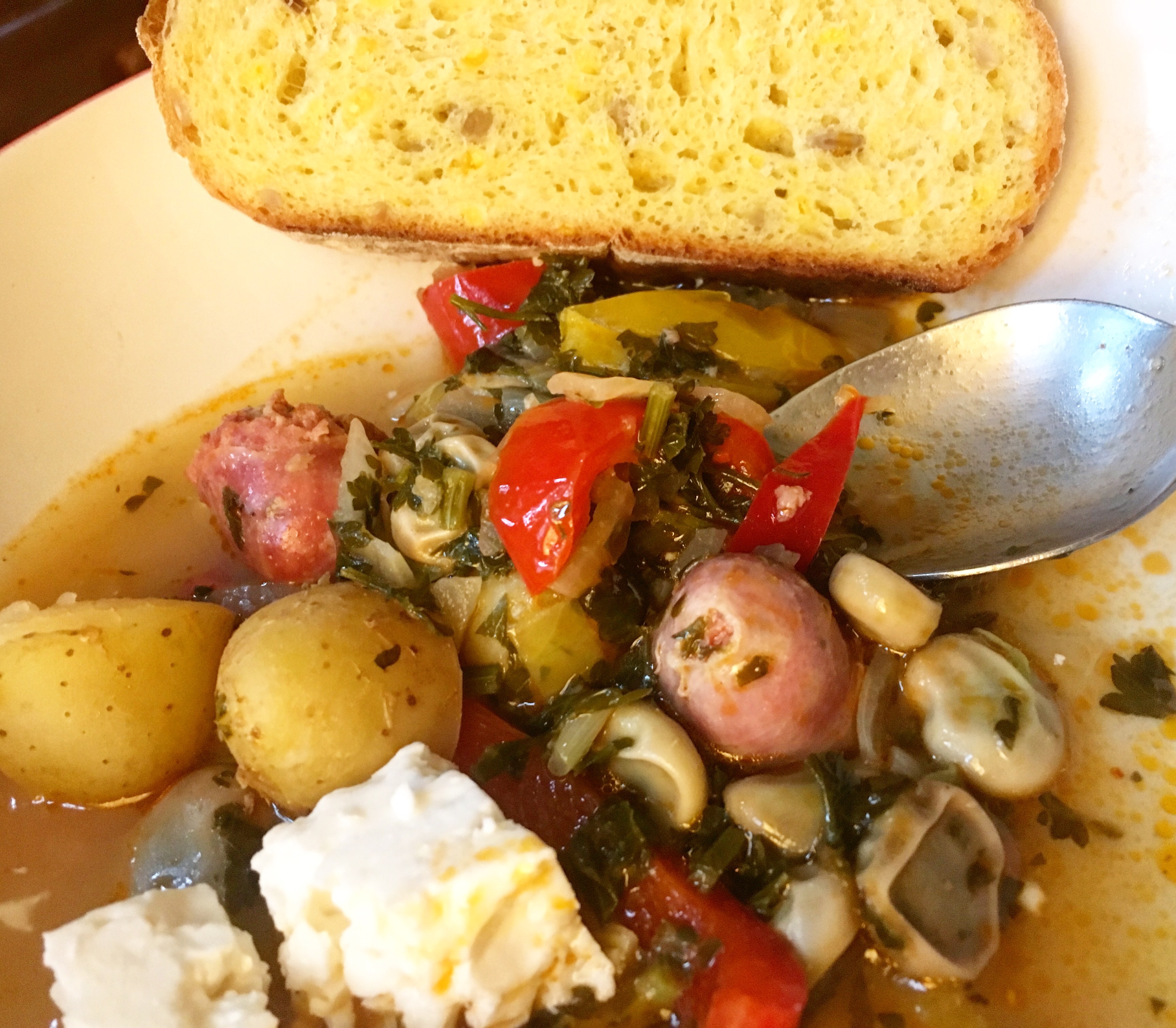
This simple sausage stew requires flavoursome, good quality sausages containing at least leek with a hint of spice, fresh seasonal vegetable and beans. The freshly podded broad beans make for a lighter and quicker version of the dish. To replace the broad beans chose either giant (Lima/Butter) beans or cannellini. As I am always inspired by my Greek heritage, Welsh producers and my local farmers’ market so I recommend you use Charcutier’s Italian fennel or their Thyme sausages for this recipe. The stew follows the same cooking method as the July 2017 Fasolakia dish which is popular in Greek cuisine. You can adapt it to make your own vegan, vegetarian and meat dishes Greek-Stylee. As usual you can source most of the recipes at the Roath and Riverside Farmers’ Market in Cardiff as well as other farmer market locations supplied by the farm in Wales.
Order your seasonal Blaencamel veg box online www.blanecamelbox.com Find out more about Lia’s Kitchen and subscribe on Lia’s newsletters here www.liaskitchen.com
Ingredients (for 4 people)
- 1 onion, finely chopped
- 1 pack Charcutier Italian Fennel or Thyme sausages, in chunky cubes (280 g)
- 1 bag Blaencamel farm broad beans, podded (250g when podded)
- 2 Blaencamel bell peppers, halved, seeded and sliced
- ½ Blaencamel Hungarian wax pepper
- 4 Charlotte potatoes, washed and halved with skin on
- Optional – half a pack of Blaencamel farm spinach (200g)
- 1 bunch of parsley, roughly chopped
- 1 Tbsp. tomato paste or 1 large tomato grated
- ½ glass white whine
- 1.5-2 tsp. sea salt
- 0.5 tsp. ground black pepper
- 2 bay leaves
- 3 parmento/all spice berries
- Olive oil or extra virgin olive oil
Preparation (60 min)
- Coat the base of a wide pot with enough olive oil to cover it.
- When the oil is hot add the cubed sausage and sauté until browned.
- Add the onion, peppers, one teaspoon sea salt and sauté until the onion softens.
- Add the tomato paste or grated tomato and fry for a couple of minutes stirring well.
- Add the chunky cubed potatoes, beans of your choice and roughly chopped spinach. Stir fry for a couple of minutes until they are well coated in tomato paste and oil.
- Add the wine and the chopped parsley. Stir well.
- Add half to one tsp of sea salt and enough boiling water to almost cover the veg and meat (but don’t submerge them).
- Stir well but before you place the lid on the pot to simmer for around 40 minutes, try to push the meat and potatoes to the bottom of the pot and the beans and courgettes closer to the top so that they steam.
- From this point on do not stir so that your vegetable does not fall apart when cooked.
- The dish is ready when the water has reduced but not fully evaporated.
- Set aside for 20-30 minutes. Or for a real Greek meal enjoy (cold or in room temperature) the next day.
Enjoy with a chilled glass of Greek Agiorgitiko Wine .
July Recipe – Fasolákia with Beef
Fasolakia is one of the ultimate summer Greek dishes. The combination of new potato crops, the abundance of parsley, the tender freshness of the fasolakia (french or runner beans) is delightful in a summer stew. When I walked past the farmer market stalls last week I just knew this dish had to return. This meal is fully inspired and sourced at the Roath Farmers’ Market. So for the rest of the Saturdays and Sundays in July, do yourself a favour and head over to Blaencamel Farm’s stall or order their box online. At the moment everything at their stall has an extra special scent and flavour – the flavour of sunshine and summer.
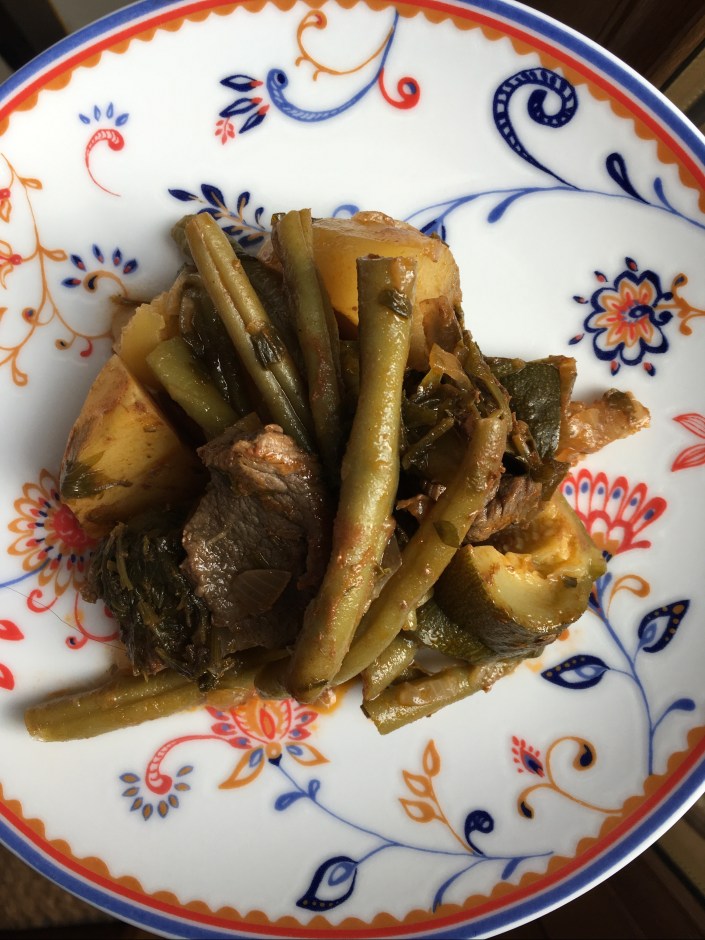
You can make a vegan or vegetarian version of this dish but this time I have included one of my favourite, top quality meats too – dexter beef from Cig Lodor West Walian farm. Like many Greek dishes it is enjoyed in room temperature or even cold straight out of the fridge to cool you down. Get some Riverside Sourdough bread (Malted Wheat & Seeds) or some of Nata’s corn bread with this and you might be having one of your best summer meals yet. Trust me.
Order your seasonal Blaencamel veg box online www.blanecamelbox.com Find out more about Lia’s Kitchen and subscribe on Lia’s newsletters here www.liaskitchen.com
Ingredients (for 4 people)
- 1 onion, finely chopped
- 1 pack of Cig Lodor cubed beef (400-500g)
- 2 bunches of French or runner beans (fasolakia), stringed, ends chopped off and halved
- 4 small to medium potatoes, peeled and chunky cubed
- 1 large or 2 small courgettes, large cubes so the don’t fall apart when stewed
- 1 bunch of parsley, roughly chopped
- 1 Tbsp. tomato paste or one large tomato grated
- 1.5-2 tsp. sea salt
- 0.5 tsp. ground black pepper
- Olive oil or extra virgin olive oil
Preparation ( 60 min)
- Coat the base of a wide pot with enough olive oil to cover it and a bit more.
- When the oil is hot add the beef and sauté until browned on both sides.
- Then add the onion, one tsp sea salt and sauté until the onion softens.
- Add the tomato paste or grated tomato and pepper and fry for a couple of minutes stirring well.
- Add the chunky cubed potatoes and beans of your choice. Stir fry for a couple of minutes until they are well coated in tomato paste and oil.
- Finally add the cubed courgettes, chopped parsley and stir well.
- Add half to one tsp of sea salt and enough boiling water to almost cover the veg and meat (but don’t submerge them).
- Stir well but before you place the lid on the pot to simmer for around 45 minutes, try to push the meat and potatoes to the bottom of the pot and the beans and courgettes closer to the top so that they steam.
- This is the biggest secret for this dish! From this point on do not stir so that your vegetable does not fall apart when cooked.
- Cook on low flame or heat for at forty-five minutes or until the water has reduced but not fully evaporated.
- The dish is ready when the meat is really easily cut with a fork (almost falling apart).
- Set aside for 20-30 minutes. Or for a real Greek meal enjoy (cold or in room temperature) the next day.
Enjoy with a chilled glass of Greek Agiorgitiko Wine , Gerovasiliou’s Avaton Limnio grade red or a Tsantali organic cabernet.
June Recipe – Pea, Broad Bean and Courgette summer risotto
A good risotto is a great dish to showcase seasonal ingredients from all parts of the world. Lia’s pea, broad bean and courgette summer risotto is inspired by Blaencamel farm’s seasonal, organic vegetable box and a popular Greek blogger video (Cucina Caruso) summing up the correct method for an authentic Italian risotto step by step. The result is a risotto recipe where Greece meets Wales and Italy in one plate.
Make sure you make time to enjoy the process of your risotto making selecting some nice music and a beautiful crisp white wine. Now more than ever we implore you to make time for the little joys in life and to enjoy the dolce vita. Eat seasonally, be positive and feel happy!
Order your seasonal Blaencamel veg box online http://www.blanecamelbox.com
Ingredients (for 4 people as a main)
• 1 onion, finely chopped
• 125g butter
• 300g Arborio or other risotto rice
• 400g courgettes, coarsely grated
• 300g fresh peas and broad beans
• 1-1.5 litre vegetable stock
• 15 g fresh mint leaves
• 1 tbsp dry dill or the tips of half a small fresh bunch finely chopped
• 100 ml white wine
• Some extra virgin olive oil
• Salt
• Freshly ground pepper to serve
• Grated parmesan cheese
• Some unwaxed lemon zest
Preparation (40min)
1. Prepare the hot stock and add the herbs to infuse it during the first stages of risotto preparation.
2. Coat the surface of a wide and deep pan with just enough olive oil and add the 50g of butter.
3. Once the butter melts add the onion with a pinch of salt and slowly sauté on low heat until it caramelises.
4. Turn the heat up and stir in the rice. Sauté for a minute making sure that every grain is coated in butter.
5. Pour a ladle of the warm stock and stir whilst the rice slowly absorbs it. Only add another ladle of stock once the previous has been absorbed.
6. When one third of the way through the stock add the peas and broad beans together with another ladle of stock and stir until the rice absorbs it. To blanch the peas and beans place in in hot water off the hob for 5 minutes. You can skip blanching if you prefer the beans al dente.
7. Two thirds into the stock add the grated courgette, stirring and allowing the vegetable juice to slowly seep out flavouring the risotto.
8. Then add the wine, stir and when it is absorbed continue adding the stock until you are left with one ladle.
9. Add the last ladle and immediately remove the risotto from the hob.
10. Add the rest of the butter(75g), stir and let the risotto set for a few minutes to create the creamy finish.
11. Serve this delicious risotto with grated parmesan, the grated rind of one lemon and freshly ground pepper.
Enjoy with a chilled glass of Greek Malagouzia/Malvasia or Assyrtiko white wine.
MealSq Menywod – Cooking from our Heartland
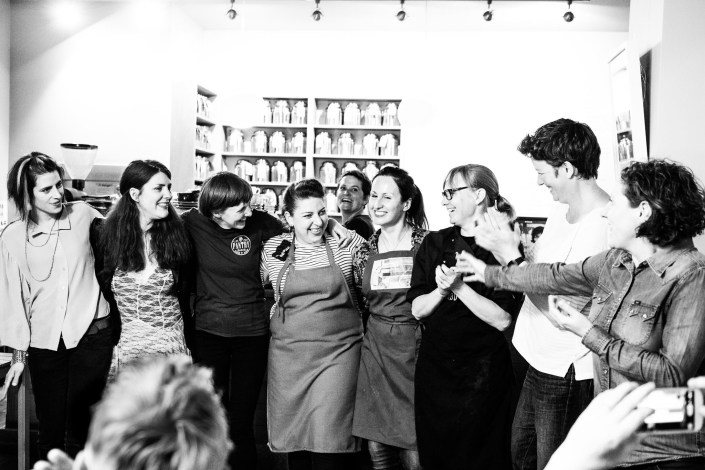
On 21 May 2017 Melissa (Penylan Pantry), Sam and Shauna (Hangfire), Bettina (Brød-The Danish Bakery), Goldie (Samosaco), Ericka Duffy (cocktail and taste expert), Ashli (Spillers Records) and I worked together to deliver a unique night of food, drink and music. What united us, apart from our extremely worthy cause to raise money for Action Against Hunger, is our passion about women leading the way in food business and good, ethical, tasty food. We delivered this event under the banner of Meal Squared, a format that delivers collaborative events and which Melissa set up last year to strengthen Cardiff’s growing independent business community.
The inspiration for Cooking From the Heartland came from the ‘Severn Sisters’ Bristol dinner organised by Romy Gill MBE and Kim Somauroo in autumn 2016. It involved women from different food cultures to create a female feast. ‘We were so inspired by our experience [of attending the event] that we decided to have our own version in Wales. Our feast, ‘Cooking from our heartland’ is inspired by the international drinks, food and music makers we know and love’, say Sam and Shauna. For me and the other women who were approached to participate in this evening there was no doubt that this was going to be our kind of fun.
This is the story of our coming together. It tells you why we chose Action Against Hunger, what ‘Cooking from the Heartland’ means to us and why we think it is so important that women work together…
I would particularly like to thank Oliveology, Blaencamel Farm, Cig Lodor Meat, All Greek Delicatessen, CocoCaravanCocoCaravan for donating ingredients for the mezze platter and dessert I prepared for the event. A massive thanks to all the other women who volunteered and worked hard on the night . And to Kas of Waterloo Tea who gave us access to his amazing restaurant/coffee house in Wyndham Arcade to run the event.
We chose Action Against Hunger because …
‘165 million people suffer from childhood malnutrition. If they joined hands, they could form a complete circle around the earth. I think this says it all.’ (Mel, Penylan Pantry)
‘When we started Hang Fire, we sofa surfed for the first year, ploughing every penny from the last pop-up back into next. Now that we have a roof over our heads, we think if you have two quid, you have a quid to share. It’s important to always give a something back. Action Against Hunger does amazing work all year round, both at home and further afield. It is our chosen partner charity this year. With everything happening in the world right now, we need to keep looking out for each other and help those who aren’t as fortunate as us.’ (Sam & Shauna, Hangfire)
‘We’re told that we’re living in exciting times of such progress and achievements in the sphere of technological development and medical advancements, yet so many children are going hungry and die of malnutrition. That isn’t right. Thank goodness for Action Against Hunger for making it their business to help those who are less fortunate.’ (Ashli, Spillers Records)
‘Nobody is immune to misfortune. People’s lives change overnight through war, unemployment, illness. People go hungry in Wales. Refugees walk thousands of miles to safety, water and food. In Greece people like us bin-dive to find food. Recently, at food community project in Uganda I often drove past international relief lorries transporting food to South Sudan and Yemen on a massive scale. I support Action Against Hunger with all my heart’. (Lia, Lia’s Kitchen)


Cooking from our heartland means ….
‘Seasonal, free thinking, creative cooking inspires me. I love nutritious, wholesome ingredients, that are good for your health, soul and mind. My heartland is wherever I happen to fall. I like to cook with local produce from the surrounding area. I feel strongly that the best way to know a new place, is to get stuck into the local food culture.’ (Mel, Penylan Pantry)
‘We are Celts and experts in the art of slow cooking and smoking. Cooking from our heartland brings those two things together to create our own version of Southern Wales style BBQ using great local produce. We take the best that the UK has to offer and couple it with the cooking techniques we learned in the States all to a soundtrack by Dolly Parton!’ (Sam & Shauna, Hangfire)
‘Baking is an important connection to my birthland. Moving to Wales in 1998, I quickly felt at home but always missed Danish bread. The rubbish Danish Pastries in the UK meant I had to set the record straight. My heartland is with my grandfather (FarFar) who was a baker in central København. My mother, grandmother and I baked to his tales of making bread (brød), pastries and cake. I’ve kept going and now I can do the same for you through Brød.’ (Bettina, Brød)
‘We live in an age where access to “stuff” in unlimited. Every thing’s a commodity. You can hear music from a culture a million miles removed from your own. You have access to ingredients from lands far and wide. Anything goes. This creates an exciting palette for a music fan or food lover. But if something is made with passion, with heart and soul oozing out of it, it hits you in the solar plexus and resonates. That sort of passion is the difference between wholesale, mass produced for the highest margin return and the real deal. I think that the unifying thing about the team bringing this event together is that we are only interested in the real deal. It’s all about passion.’ (Ashli, Spillers Records)
‘The Heartland theme meant exploring my connection to Wales which for me revolves around art and literature. My cocktails are inspired by the Davies sisters who contributed much to the artwork and culture that enthrals me about Wales. They bought whole galleries of artwork (Monets, Manets, Rodins). They established Gregynog Hall as a centre of excellence for the arts, crafts and music. Most importantly, the Davies Sisters took in Belgian refugees including the sculptor George Minne, and the painters Valerius de Saedeleer and Gustave van de Woestyne. All three artists were to spend the rest of World War I largely dependent on the Davies family for support. You can visit the Davies Galleries at National Museum of Wales, Cardiff.’ (Ericka Duffy, Cocktail and taste expert)
‘Cooking from the heartland brings you the taste of my Greece whilst mixing it with world food influences, and good Welsh/UK produce I discovered in the past twenty years living away from the birth land. My platter is about ingredients from some of the businesses involved in the collaboration, whilst I introduce you to some of my favourite Greek and Welsh, UK- based businesses. And every dish reminds me of someone I love. My Yaya (Grandma) for the boozy tzatziki, my Mana (Mom) for the meatballs and my Aderfo (brother) for the fava dip.’ (Lia, Lia’s Kitchen)


Women should work together …
‘Women make up 43% of the agricultural labor force in developing countries, and account for about two-thirds of the world’s 600 million livestock keepers. Still to this day millions of women and girls around the world are discriminated against simply because they are born female. Events like International women’s day send a message of unity, solidarity and compassion. I hope MealSq Menywod sends out the same message on a smaller scale. Gender discrimination should not be accepted in this day and age.’ (Mel, Penylan Pantry)
‘We have always championed the idea of bridging the gender gap in any industry, and the hospitality industry is no different. We’re surrounded by talented, courageous women who are a daily inspiration to us. It’s a great privilege to come together and produce an event that is not only authentic but heartfelt from some incredible women truly passionate about what they do.’ (Sam & Shauna, Hangfire)
‘In the words of Poly Styrene “Some people think little girls should be seen and not heard. But I think “oh bondage, up yours!”. Being a go-getting female with a lot of knowledge in your field, you often have to play down your expertise and shrink below your ambitions. With politics at the forefront of many people’s minds at the moment, it’s important to remember that not so long ago women were denied the basic human right to have our say. But let’s not forget we are the lucky ones. Many women worldwide still do not have the right to exercise their own choice. In the face of regressive steps the world has taken lately we must continue to fight for our rights and demand equality.’ (Ashli, Spillers Records)
‘I like working with inspirational people, both men and women. But I think this is an event that shows how we women can support each other in business.’ (Bettina, Brød)
‘This meal presents females who work in flavour and taste – each of us in traditionally male-dominated fields. Between our different skillsets, point-of-view, and aesthetics there is a collaboration occurring – from baking, Greek cuisine, smoking, cheese pairing, cocktail mixing, and the music selection by the World’s Oldest Record shop.’ (Ericka Duffy, Cocktail and taste expert)
‘I have had fun and struggles being a female immigrant claiming my place in Britain! As a Greek girl, I was often stereotyped to suit the service industry just fine but some people were shocked I was also a law graduate, a young lecturer or that I chose to start my own food venture. I have had many lives. I refuse to be pigeonholed. And women should fight together against prejudice. Antagonism is not a female trait so it’s time to resist being turned into alpha-males. Our global village relies on running it together. There is space for everyone. Don’t let anyone tell you otherwise.’ (Lia, Lia’s Kitchen)
May’s Recipe – Vegetarian Mageiritsa, a Greek soup of greens and mushroom

May is the period of the hungry gap but at Blaencamel Farm where, during this period of summer anticipation , they continue to grow nourishing greens. Gem and pink, and green Battavia lettuce have appeared on the stall. There is spinach, sweetheart cabbage, wild and green garlic. Whilst the seasonal bouquet garni can complement the dill that makes this spring soup so special.
May’s recipe is a Greek traditional Easter soup with a Welsh and clean-eating twist! Mageiritsa is traditionally cooked with lamb’s liver and plenty of greens and salad leaves. This is a vegetarian version and could be made vegan if you choose to not use avgolemono, the egg-lemon sauce typical of many Greek recipes. If you live in Wales what makes this Mageiritsa extra special is using dried kelp from Pembrokeshire. And the final Greek note is the use of the tangy and sharp sea buckthorn berry, which is becoming a staple in my cooking this year.
Visit www.liaskitchen.com for more ideas and monthly seasonal recipes inspired by Blaencamel Farm’s crops.
Ingredients (4-6 portions)
- 1 onion, finely chopped
- 1 -2 leeks, finely chopped
- 1 green garlic or 1 bunch of wild garlic
- 500-700g finely chopped mixed Blaencamel greens, such as spinach, lettuce and/or sweetheart cabbage
- 500g mushrooms, Blaencamel farm or chestnut if they are not available
- 1 punnet of mixed Blaencamel farm herbs (fennel, sage, mint, thyme) (Optional)
- 1 finely chopped bunch of dill or 1 tbsp. tried dill
- 2 Tbsp. uncooked rice
- 1 heaped tsp. Pembrokeshire Beach Company Kelp or other dried/crumbled sea weed (optional)
- 1 tsp. sea salt
- ½ tsp. ground black pepper
- 1 tsp. sea buckthorn berries roughly chopped (optional)
- Extra virgin olive oil
- Around 2 litres of stock
For the Avgolemono sauce:
- 1 small egg
- Juice of one small lemon
Preparation (45 minutes)
- Coat the base of a deep pot with olive oil and sauté the onion and leeks with one teaspoon of salt until soft and translucent.
- Add the cubed mushrooms (2 -3 cm chunks) and sauté for 2-5 minutes.
- Add the finely chopped herbs, wild or fresh garlic and greens, and stir fry for a couple of minutes.
- Then add the stock, stir well and (if you are using) add the dried kelp or other sea weed, pepper and sea buckthorn berries.
- Simmer for about 10 minutes and then add the rice.
- After 20 minutes (when the rice has softened and soup has thickened) remove from the hob.
- Beat the egg really well until it is fluffy and creamy (around 5 minutes), and whilst you continue whisking gradually add the lemon juice.
- Take one ladle of hot stock from the soup, strain through a fine sieve and add the hot stock slowly to the egg-lemon mixture whilst still whisking on low speed or by hand.
- Finally add the thinned egg-lemon and stock juice to the hot soup stirring in well to make sure it flavours and thickens all of the soup.
- Taste and adjust the seasoning if needed.
April Recipe – Spinach, chard and leek risotto
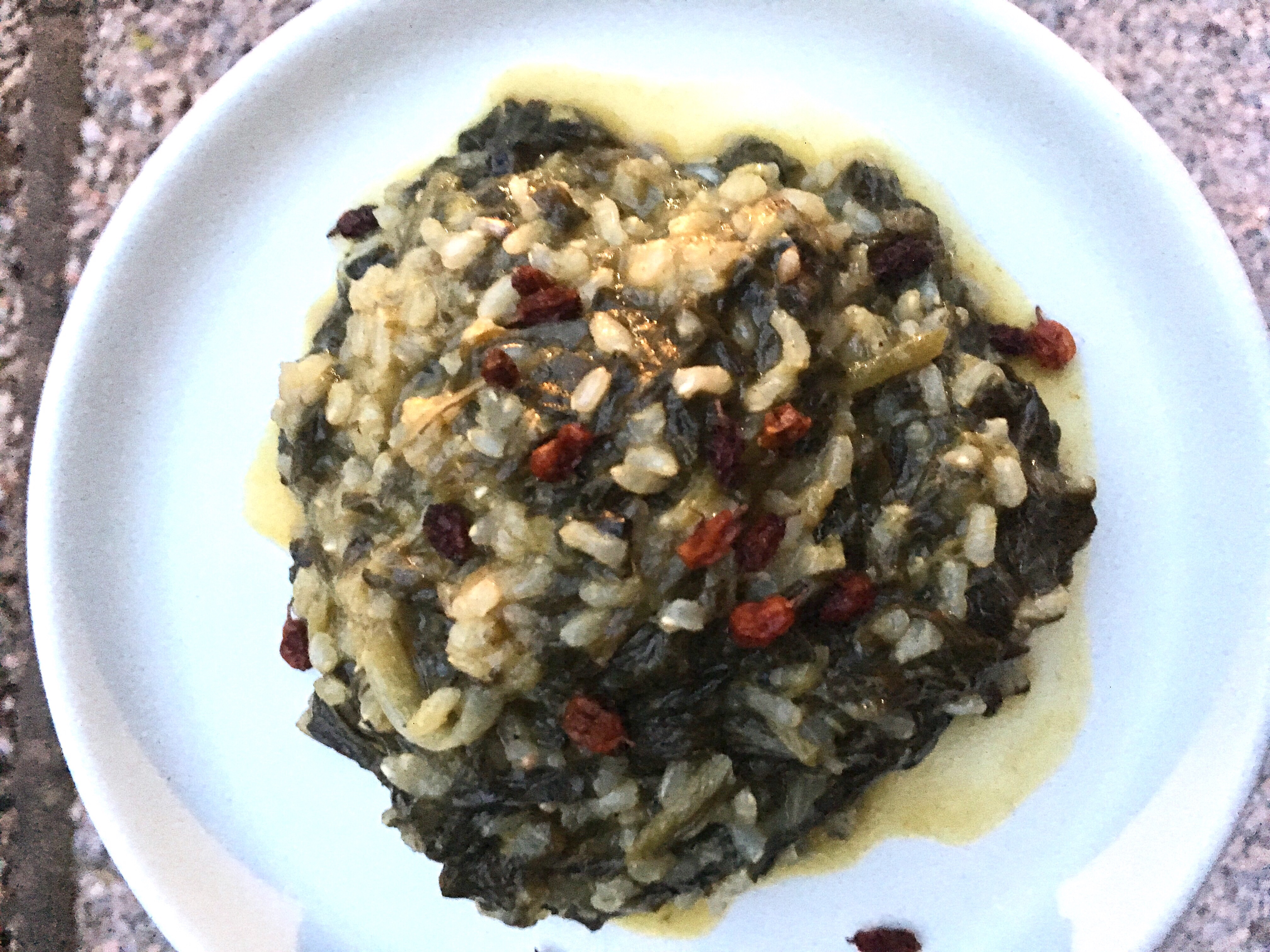
In April return to Greece for culinary inspiration. This month’s recipe is a risotto dish much loved in my homeland and to make it I am using seasonal organic Greens from Blaencamel Farm in West Wales. The key difference of this Greek risotto, called ‘Spanako-rizo’ or ‘Spanakoprasó-rizo’ is that it is less complicated in its cooking process (when compared to its Italian cousin) and it uses a lot of greens as the star ingredient rather than focussing on making a creamy rice. Whilst the rice is also added before the water it does not follow the Italian risotto method and you add all the water at once simmering the rice slowly to complete the dish.
Traditionally this dish is made with a rice called Karolina. In the UK, you can find this in Greek specialty shops, but also on the shelves of many of the Middle Eastern shops where you should seek it as Egyptian Rice. It is a short grain variety which keeps its bite when compared to Arborio. If you cannot find Karolina/Egyptian rice why not try Thai Jasmin rice which I find is a great replacement for many Greek recipes. In fact, as I am not a purist, I recommend that you try this dish with all rice varieties to find your preferred version.
Chard is regarded a wild green in Greece and has traditionally been foraged. Now cultivated widely in farms such as Blaencamel it has become a staple of our diet in the UK. Which is why I am using it together with spinach. Its meatier leaves, organic spinach, delicious Welsh leeks, foraged wild garlic and wonderful onions complete this version of the dish. In fact, Blaencamel farm’s April box will include all the ingredients you need to make your Greek Risotto. A perfect gift of the emerging Spring time and a great dish to help your body detox the heavy flavours of winter!
Ingredients (4 portions)
- 300g Blaencamel leeks (1 bunch), sliced
- 450g spinach (1 bag), roughly chopped
- 450g chard (1 bag), roughly chopped
- 1 medium onion, chopped
- 1 bunch wild garlic
- ¾ cup of rice
- Juice of one small lemon
- 1 tsp. tomato paste
- Up to 2 tsp. sea salt
- ½ tsp. black ground pepper
- 1 tbsp. sea buckthorn berries (optional)
- 1 finely chopped bunch of dill or 1 tbsp tried dill
- Extra virgin olive oil
Preparation (30 minutes)
1. Coat the base of a 20cm pot with olive oil and sauté the onion and leeks with one tsp of salt until soft and translucent.
2. Add the tomato paste and stir well.
3. Gradually add the chopped greens (spinach, chard, wild garlic) so that wilt slightly.
4. Add the raw rice and mix well.
5. If using chop the sea buckthorn berries roughly or crush and add to the rice and green.
6. Add the lemon juice, around two cups of boiling water, dill (if adding), another teaspoon of sea salt and the pepper.
7. Simmer for 20 minutes or until the water is absorbed.
8. Serve with more crushed sea buckthorn, some feta cheese and drizzle with raw olive oil.
Organic Greek Leek pie
Most of the people I know in Britain talk about how much they love Greek spanakopita (spinach pie) but my all-time favourite is actually Greek leek pie (prasópita). What best way to bring together my two homes other than in this wholesome, winter recipe?
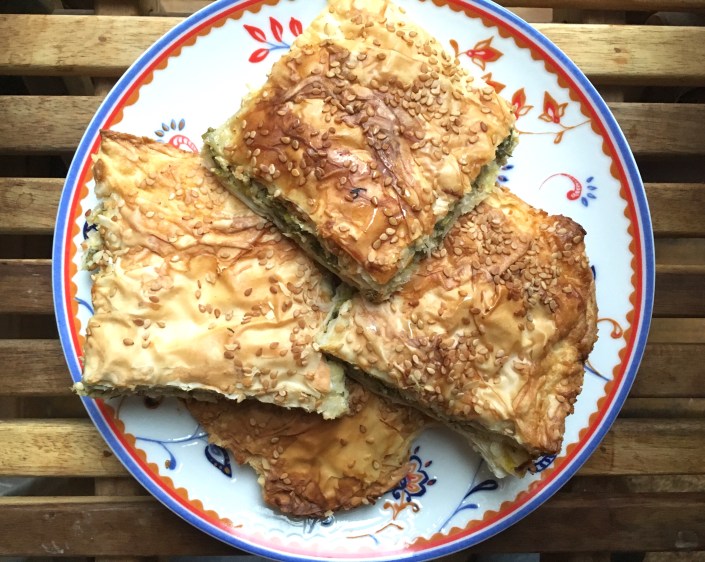
Leeks are currently in season and Blaencamel Farm’s boxes and market stalls showcase this wonderful Welsh ingredient. You can make this pie using a couple of organic bunches of leek and one onion. And you will thank me for it as the flavour of Blaencamel’s leeks is special. Every bite will make you feel nourished and shun away the winter blues. Happy pie eating!
You can order Blaencamel Farm’s boxes by contacting emailing Tom Frost mailto:(tom@blaencamelbox.com). For more info click here.
Join Lia’s Kitchen cooking classes on 3 and 10 February to find out more and savour Greek cuisine. Book here: https://www.eventbrite.co.uk/o/lias-kitchen-7901836356
Ingredients (4-6 portions or 12 pieces)
- 2 bunches Blaencamel Farm leeks (around 700g)
- 1 onion
- 200g Feta cheese
- 2 organic eggs
- 15g fresh dill (optional)
- 1 tsp. salt
- 1 tsp. sugar
- ½ tsp. ground black pepper
- 250g filo pastry (packs available at most supermarkets)
- Olive oil for cooking and pastry basting
For the glazing
- 1 espresso cup milk
- 1 tsp. butter
- 1 tbsp. sesame seeds
Preparation (up to an hour)
- Peel, halve and slice the onion finely.
- Rub the salt and sugar in the onion slices with your finger until they are well separated.
- Let the onions sweat for ten minutes.
- Meanwhile trim the leeks and halve lengthwise. Place in a basin filled with water and rinse well to remove all dirt from between the layers. Repeat at least twice.
- Coat the base of a wide pan or pot with enough olive oil and preheat. The pot or pan should have a lid.
- Add the onions and slowly fry, covered until they caramelise.
- While the onions caramelise slice the leeks finely or roughly.
- When the onion is ready add the leeks and stir fry for ten minutes on medium heat until softened.
- Remove from heat (and pan if possible) and cool down.
- In a big bowl beat the eggs lightly and crumble the feta cheese.
- Add the leeks and onion mix to the eggs and feta. Add the pepper and mix well.
- Pick a baking tray (around 36cmx40 but can be a bit bigger) and using a brush or your hands oil its base and sides well.
- Layer half the filo pastry sheets one by one (6-8 depending on the pack), lightly oiling each sheet with olive oil using a brush or your clean fingers.
- Don’t oil the last sheet and pour the leek pie filling spreading it evenly across the tray with the back of a spoon.
- Repeat the layering process over the filling.
- Heat up the milk and butter in a small pot until the butter melts.
- Pour on top of the pie, starting from its edges but making sure that the full surface of the top sheet is also moistened. Tuck the corners in to seal the pie.
- Using a sharp knife slice the pie into twelve portions.
- Sprinkle the sesame seeds and bake in a medium oven (180 Celsius) for 30-45 minutes until golden.
All you need is love … and chocolate coated, caramel almonds

Happy St Dwynwen’s Day you lovely people! So proud that in Wales we have a lady patron of love.
Last week the amazing We Are Cardiff blog asked me to develop a recipe for them! And here it is together with the full blog.
wearecardiff.co.uk/2017/01/23/all-you-need-is-a-love-inspired-recipe-for-saint-dwynwens-day/
Remember to find out more about Greek food join one of Lia’s Kitchen intimate cooking classes on 3 and 10 February. I will be introducing participants to Greek Kitchen basics but will also be sharing Greek flavours and recipes that are not yet widely known in the UK. You can book online here www.eventbrite.co.uk/o/lias-kitchen-7901836356.
Or contact Lia for more information at lia@liaskitchen.com.
The story of my August dinner


My pop-up dinner at Cardiff’s Street Food Circus in August 2016 showcased one of my most favourite menus to date. Food inspired by my homes of Greece and Wales was served under a canvas tent and the leafy trees of Sophia Gardens, in the green heart of the city centre at a pop-up restaurant operated by Milgi Cardiff.
I cannot think of a menu that sums up the Lia’s Kitchen approach to cooking and dishes better. It’s based on how I eat and my adventures in food. I am always on the look-out for fantastic, local and sustainable produce and products from my Greek and Welsh homes to integrate in my cooking. And I always try to showcase producers, flavours and ingredients that you might not have heard or savoured, like for example salepi, the wild orchid powder that flavoured my yoghurt ice-cream desert.
And here’s one other very important thing. I work with people I like and whose business I respect. Their produce/product is as good as their business and working ethos. I love what they do and how they do it. And this is why I believe I should tell you about them. They provide me with daily inspiration and nourishment, and they are or are becoming good friends in the most beautiful, unrushed, organic way.
1.Tom Frost and Blaencamel Farm work tirelessly through the seasons in a fertile valley of West Wales, between river and coastline, and grow vegetable using organic, biodynamic methods. Their land is unadulterated and pristine. The food is nourishing and full of unique flavours. For my August menu I used organic aubergines, tomatoes, chard, cucumbers, beetroot grown and summer salad leaves grown in Wales. Their vegetable is the perfect match for my recipes and some of the great Greek products I have sourced.


2. Marianna and Oliveology are based in London Borough market. She sources her olive products from a small, organic farm in Sparta, Greece. She also sources other organic and wild, foraged goods from the Peloponnese. I swear this is not a sales pitch, they are not paying me – I urge you to try their products for your taste buds’ happiness and your soul’s nourishment! Together with their organic grape molasses and their fantastic Agiorgitiko grape balsamic vinegar, I used their 18 degrees organic, extra virgin olive oil (so aromatic but delicate at the same time) to dress Tom’s fresh salad leaves. I also used their white balsamic vinegar with Greek honey and Oliveology’s flavoured extra virgin olive oil (rosemary, purslane, walnut, oregano) – another product on my menu exceptionally high in Omega 3 – to dress a summer vegetable slaw, made mostly with Tom’s vegetable too. The success of Oliveology’s products is that their quality will not let you down and their flavours are distinct but well balanced. As my one of my diners said: ‘You can taste every single flavour but it doesn’t punch you in the face’. I think Oliveology’s products are an experience you should not miss.


3. Benni Thomas and Cig Lodor Meat are a butcher business based in Carmarthenshire Wales. I eat meat once a week (or less than that) and it is mostly if not exclusively from Benni who supplies both Riverside Farmers’ Markets in Cardiff. Benni supplies me with Dexter Beef which is what I used for my Moussaka main dish. Not only does the grass fed beef taste like no other, it is also contains almost as high Omega 3 as oily fish (for example mackerel). It has a rich and moreish flavour that complements creamy béchamel dishes, a tomato sauce with hints of cinnamon and loves to be cooked with the meaty aubergine! I use it in burgers and stews, and everything I cook really. With such low carbon footprint this beef should satisfy the most environmentally conscious person. So if you live in Wales and you have not tried Benni’s products I think you should definitely put it on your to-eat list.


4. Jacque and CocoCaravan make delicious raw chocolate and hot chocolate drinks. I use the vanilla and cinnamon cocoa powder every day and for my August menu I sprinkled it amply on the Greek yoghurt ice cream served for the last course. I also coated my homemade pasteli (Greek Sesame and pistachio energy bar) in melted CocoCaravan’s raw, dark chocolate. Jacque’s chocolates, which he started making in Wales a few years ago, are creamy and melt in your mouth, their flavour is subtle and the digest incredibly easily (compared to other chocolates) in my opinion. His products are just incredible.


6. Mel, Jo and the Penylan Pantry are a sustainable, local corner store/cafe/deli a stone throw’s away from my Cardiff home. These days I only change Blaencamel as my vegetable supplier for the Penylan Pantry, who source organic vegetable ethically from around Wales, UK and Europe. The stepped in to source additional vegetable for the menu as part of their weekly vegetable box scheme. They also have one of the biggest selections of delicious British cheeses I have found in a place in Cardiff and I just love them. And their home is one of the brightest, cosiest cafés in Cardiff. If you have not lounged and shopped there yet, do it soon!

Lia’s Kitchen’s next event is on 8 October 2016 at Slow Food South East Wales’s Dunraven Bay festival. We will be serving Greek pies made with organic chard and foraged nettles from Bleancamel Farm
 Lia's Kitchen
What about Perek?
Posted on Updated on
A few months ago, when I sat at the table with Maria Mouratidou to talk about Perek Farm near Thessaloniki, Greece I thought I would hear the story of a cooperative, a successful entrepreneurial model, which flourished in a Greece of adversity. But my conversation with Maria told me more about how food could help reframe our lives and reality. How important it is in preserving heritage, the recollection of which is starting to dwindle together with the lessons it has to offer. And how a different way of producing, farming and living could be one of the ways for a brighter personal and global future.
Greece is often branded as one of the most biodiverse, fertile and blessed soils in Europe which apparently can yield more produce per square mile than many of its neighbours. Yet it is in crisis. And the Greeks are running to supermarket chains offering them mass produced food from far-away lands. What has gone wrong?
Recently as I listened to BBC Food programme Sheila Dillon’s voice narrating the struggles and opportunities facing Greek agriculture I was reminded how hope is reborn by necessity, simplicity and through turning to the land. I come from a generation of Greeks whose parents left the countryside for a better future accessible through academic education. And here I am asking myself how many educated ‘fools’ does it take to break a country? Or could we turn our skills and knowledge to tools that could help us reframe reality for the future in Greece and around the world.
So what about Perek? Here’s my take on its story as a family business and an example of how our life, economy and nutrition could be reimagined.
What about Maria?
Maria is a sprightly, ageless lady, who left her academic career in 2003. She worked in molecular biology at the Aristotle University of Thessaloniki Medical School. This gave her a sound basis for understanding the links between intensified agricultural practices, the use of pesticides and the increasing health impacts experienced by many of the farming communities where agriculture grew in concentrated pockets of land mass. Maria was also looking to change the pace of her life. ‘We wanted to live’, she says, ‘to enjoy the sunsets and to take time to breathe in the lavender. We never imagined that we could do so much for the people around us. We never knew’.
And so was Perek set up. Initially as a small business that produced traditional pasta and pie products typical of Northern Greece and the Pontos such as Trahanas (often fermented Greek pasta grain); Verenika (tortellini -like dumplings with various fillings encountered in other neighbouring cuisines such as that of the Ukraine); Ivristos (vegan pasta similar to tagliatelle but broken, dehydrated and toasted to enhance preservation); Perek pastry (large, thick filo pastry toasted and filled with greens or cheese or other goods); sourdough breads and specialty cakes flavoured with Tsipouro. All these goods used specialty wheat and rye varieties carefully selected for each product, grown and milled locally by farmers carefully chosen for their practices.
‘Subconsciously I looked at what my mother did’ says Maria. ‘I wanted more than just a business and to preserve methods, foods and practices from our long-lost homes in Pontos, Kerasounta’. There were many women in the area of the same micro-heritage that Maria could work with. So a workshop was set up and the reputation of its quality produce grew and grew. People visited to stock up on supplies, the place was like a magnet pulling in those seeking to reconnect with tradition and practices that Perek had to offer. The quality and flavour was unparalleled.
‘It was as if we had made a Nobel prize discovery, when all we had done was use resources grown in tune with nature. We made what we knew from our grandmothers and mothers – recipes and traditions handed down generation to generation. Gradually people started asking why they could not taste recipes with food they bought, why there was no restaurant on the premises. We were lead to growing as a business. As we say in Greece ‘the route leads the walker’.
Perek’s growth (?)
Maria applied her scientific knowledge in seeking wheat, dairy and meat produce that was uncompromised. ‘As a scientist I felt it was essential to make an alternative suggestion to society to help rectify the damage done to our ecosystems, society and health. We have an obligation as scientists to talk about the impacts of chemicals on our food and genetics. And I wanted to also talk about the ‘science’ of tradition. To look deeply into our heritage and see how it leads us back to understanding the basis of longevity and how to enhance biodiversity’, Maria says.
‘All you need to do is watch and listen to each place (the Topos). The hint is often in the names of places, Ampelotopos or Agrampelo (the vine meadow), Karpouzlouko (the water melon field), Kapnohorafo (the tobacco plot). There is a reason for these names. People observed what grows and doesn’t grow well. Then they rested the land. They swapped crops’, she continues. ‘And you must remember, tradition does not focus on loss and profit and mass production. It is about making do, health and wellbeing’.
With the help of her daughter, a food scientist who researched Meznikof’s work and returned to Greece to be part of the business, Perek grew. Today the business employs over forty people. There are at least five regular animal farmers it collaborates with as well as an array of carefully selected artisan businesses.
The Perek Restaurant, a beautiful stone building with a large cyclical fireplace/oven in the middle, overlooks Thermaikos Bay and looks at Mount Olympus. It feeds up to 2,500 people each week and is supplied by the Perek workshop which continues to provide employment to many women and communities in the area. Perek supports free range farmers whose produce it uses for the restaurant, whilst it has also set up its own small farm mainly focussing on the rearing of black pig pork, indigenous in Maria’s home land. The pies, including the amazing Perek pie, often use wild greens (Horta) such as purslane, amaranth and nettle. Stipa (Toursi), fermented cabbage similar to sauerkraut and kimchi, feature on the menu. Katsikisio tyri, goat’s cheeses from free range animals and Greek varieties of chickpeas, lentils and other pulses also feature on the menu. It is the place to visit if you want to taste the land’s flavours.
‘One of the positive impacts of the crisis, was the lack of money to buy some of the expensive, industrialised animal feed which increased productivity and commercialised dairy and animal farms. This hit farming in Greece badly. But the remaining farmers downsized and turned to grazing and traditional methods of feeding. Production rates decreased but quality improved. The taste of the milk and cheese for example is now more distinct of the land’s vegetation’, Maria explains.
With a model so successful there could be temptation for Perek to grow and expand. Make no mistake, Maria is a business woman, savvy, clever and resourceful, but her message is unequivocal. ‘We supply twenty to thirty external businesses at the most. There are limits to how far we can go without compromising quality and the ethos of our business. We will produce enough for our restaurant, our own shop and some suppliers but we cannot supply everyone. There would be costs to that and we have to be careful’.
The meaning of life…
When Maria left her academic career for a different life she was ill. ‘Cancer made me revaluate life. I asked myself why I am running around like a mad woman. Why do I never have time? Why do I struggle?’, Maria told me. Can you relate to this too?
To me Perek is more than just a food business. It is a model and a way of business the depths of which might not be appreciated by everyone but its restaurant service for example remains accessible to the average Greek living in the area. And this is what makes it so amazing. That you can have quality in flavour, produce and life. That you can support ethical practices and communities through a conventional business model which is not willing to compromise its ethos. That you are able to preserve the elements of different segments of Greek traditions and tribes which shed light into who we are, how we can live more healthily and how we can connect to our neighbours.
I am not going to demonise where we are as a global society today, it gets tiring. There is a reason we made this journey through progress and perhaps now we are better equipped to move on into the future. Take Perek and Maria’s story as an example of how our and future generations could take academic excellence, skills and knowledge and apply it towards a different direction awar from our conditioned aspirations of achievement and wealth. Towards a more meaningful future for us, our friends, our nature and our children. Just take that.
Visit Perek farm all year around from Monday to Sunday. For more information here: http://www.perek.gr/ . Visit Perek on facebook here: https://www.facebook.com/pages/Perek-Restaurant-Monopigado-Thessaloniki/387257144667373
Share this:
This entry was posted in Comment, Travel and tagged community, farming, farming today, greece, greek, northerngreece, perek, pontos, sustainability, thessaloniki, traditional agriculture.